












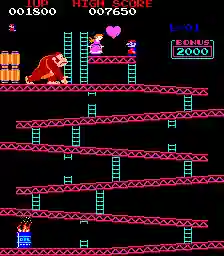



Overview
Core Game Overview
Donkey Kong Jr. (Japan) is a FDS platform game centered on movement rhythm, jump timing, and route discovery. Notable details include role reversal narrative. Best suited for players browsing Donkey Kong, Platformer, Famicom Disk System entries. Title markers such as Japan, Disk Writer help separate this FDS entry from nearby regional or build variants.
Donkey Kong Jr. (Japan) is an FDS platform game centered on movement rhythm, jump timing, and route discovery. Notable details include role reversal narrative. Best suited for players browsing Donkey Kong, Platformer, Famicom Disk System entries. Title markers such as Japan, Disk Writer help separate this FDS entry from nearby regional or build variants.
What Sets It Apart
Donkey Kong Jr. (Japan) stands out through stage hazards, enemy placement, and momentum control.
- Role Reversal Narrative: Flip the script from the original game and save Donkey Kong from his captor, Mario, the now-antagonist holding DK prisoner in a steel cage.
- Inventive Vine Gameplay: Navigate vertically-oriented levels by expertly climbing chains and vines to reach higher platforms while navigating dangerous creatures trying to knock you off.
- Key Collection Challenge: Rescue DK by collecting keys from across multiple distinct boards, each with unique environmental hazards and increasingly tricky enemy patterns.
- Canon and Character Origin: The game’s narrative officially established Donkey Kong Jr.’s existence and heroic stature, showing the full Kong lineage and the character’s eventual evolution into the modern Donkey Kong.
- Masterful Mechanical Ingenuity:
Practical Play Notes
Playing Donkey Kong Jr. centers around rescuing the captured Donkey Kong by outmaneuvering the enemy creatures Mario sets on your path, across increasingly demanding courses.
- 1. Learn Your Jungle Moves: Use the arrow keys or WASD for movement, and the 'Z' or 'X' key for action (often jumping and throwing) with space sometimes performing a jump, giving you both the agility to climb and the precision to toss projectiles at enemies and obstacles.
- 2. Climb and Rescue Strategically: Navigate through four distinct Boards, with titles like Forest (Vines/Beetles), Cable (Snapping/Flashing Snap-Jaws), and Spark. Collect all keys safely, often dropped after defeating animals, to advance each stage.
- 3. Defeat Mario and Beat the Game: Progress through each board’s sequence by mastering climbing rhythm and enemy patterns, ultimately unlocking the final cage to defeat the new villain and enjoy a satisfying cutscene of Donkey Kong Jr. riding on big DK’s back to victory.
Entry Notes
Donkey Kong Jr. (Japan) is cataloged as an FDS entry. Title markers such as Japan, Disk Writer help separate this FDS entry from nearby regional or build variants. The current tags are Donkey Kong, Platformer, Famicom Disk System, Japan Release, 8-Bit, which help group the page with similar games without relying on a single generic label.
Practical FAQ
How many levels or 'Boards' are in DK Jr.?
There are 4 main, distinct Boards: the Forest (the only Board in some early versions), Labyrinth, Springs & Rivets, and Cable. Many loops involve the 25m/50m variants returning as a 'Plus' set.
How do eggs/sparks work?
Hold Z/X to set speed/trajectory when touching eggs or the spark enemies produce for throwing, and time the release to knock out smaller birds/knitting enemies or deactivate electric barrier sparking foes.
Do power-ups exist?
Not in the traditional sense. Thrown eggs themselves or contact with specific temporary power items like the 'N' for invincibility from the original arcade may not be present or identical in this re-themed FDS Board version.